Rich Media: Format Follows Behaviour

The Problem
The Nepal Remote Engagement System (RES) is a WhatsApp-based program connecting pregnant and postpartum mothers with health guidance between clinic visits. Despite its reach, long text-based messages weren't working. Engagement with mHealth interventions drops significantly over time PubMed Central — caregivers weren't responding, repeated the same questions, and health workers spent extra time reformatting every message just to make it readable.
The content existed. It just wasn't landing.
My Role
I led creative strategy and documentation across both formats — framing research questions, designing the format decision framework, and for YouTube Shorts specifically, handling storyboarding, art direction, and creative direction within tight budget constraints, maximising existing resources to keep production lean.
What We Designed
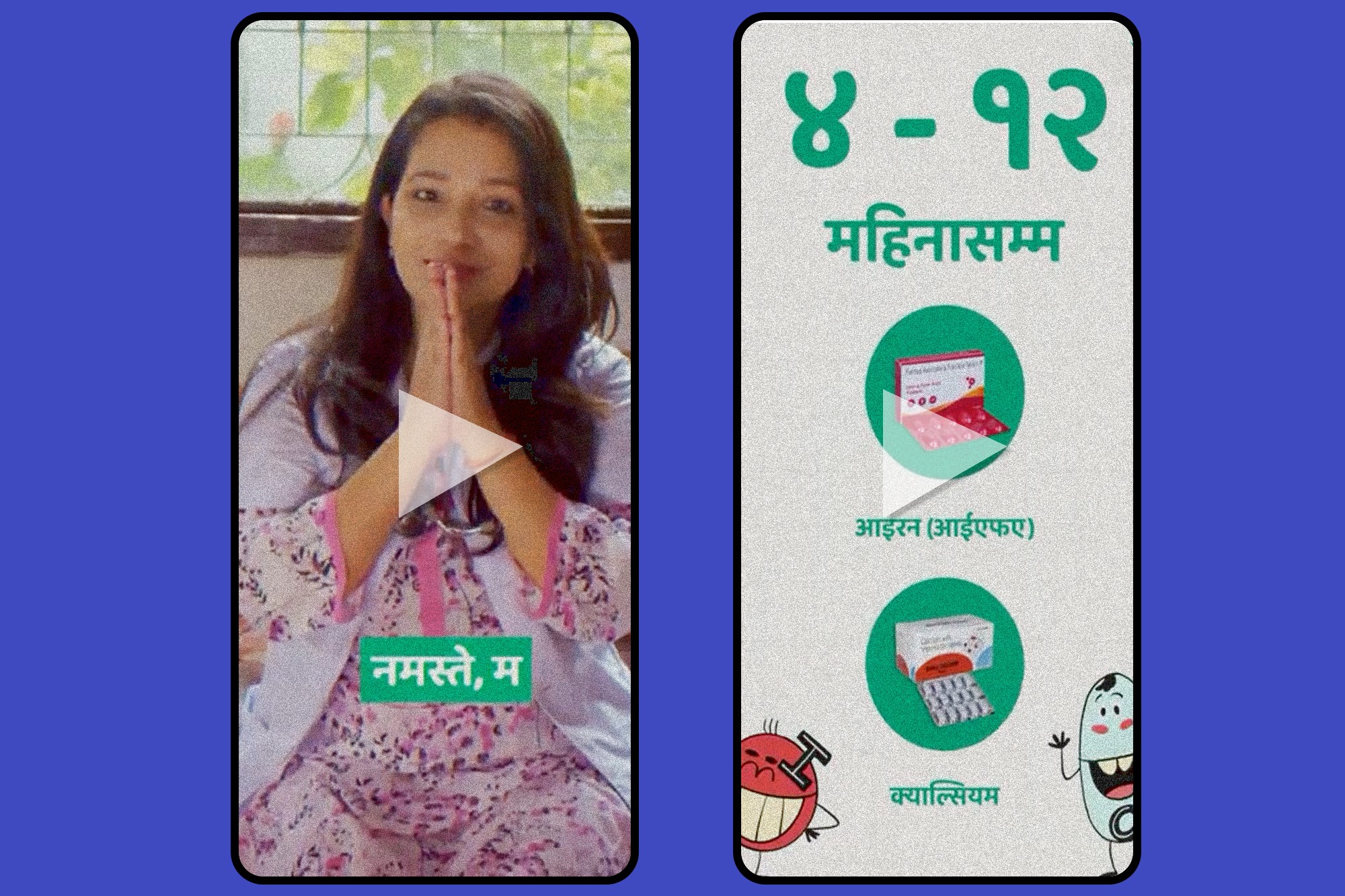
FAQ image tiles — visual WhatsApp cards built from the Nepal FAQ bank, designed for single data points where no link click is required.
YouTube Shorts — under-45-second videos with Dr. Pallavi, a fictional but credible female doctor, because field research confirmed that patients trust and engage more with content attached to a medical identity. Field observations showed ANC mothers already searching pregnancy health queries on TikTok and YouTube — the platform choice followed the behaviour, not the assumption. YouTube was chosen specifically for low bandwidth, no phone storage needed, and local-language search already happening there.
The content was also designed to navigate intergenerational tension — younger mothers actively use online health content to question older caregivers' traditional practices, so Shorts were framed to offer respectful but firm alternatives: "nowadays, doctors recommend..."
The formats worked as an ecosystem: Shorts attract, long-form films deepen, Shorts reinforce.
Process
What started as a text and video link pilot in February–March 2025 evolved into a full rich media campaign by August 2025, with tiles and Shorts introduced into the live RES campaign and tracked across six dimensions.
Shorts followed a tight structure — 6-second hook, 30–35 seconds with Dr. Pallavi, 5–8 second takeaway — distributed via WhatsApp link with a follow-up prompt to close the feedback loop.
"I watched it multiple times and also showed it to my wife." Husband, ANC caregiver, Nepal
"I was confused about calcium dosage — after watching the video, I understood it better." Pregnant mother, Surkhet
Outcome
The shift was immediate and specific. Users who received a breastfeeding tile didn't just engage — they asked two new follow-up questions on topics they hadn't raised before. Repeated questions dropped across the board. The before-and-after was clear in Rabina's own words:
"Before, I used to probe them for a response. Now they are responding themselves."
"Users are not asking repeated questions after using tiles till now."
"Earlier I used to break lengthy textual answers by highlighting the exact keyword/sentences that answers a user FAQ." Rabina, Health Worker, Nepal RES
One honest nuance: tiles were adopted immediately, used daily for quick facts and reminders. Videos were adopted more slowly — valued for complex, step-by-step answers where retention mattered more, but health workers were unsure if users were opening links. Findings shared at a cross-team session on September 8th 2025.
One clear design principle emerged: the FAQ bank, not editorial logic, should always anchor content decisions. What changed wasn't just the format. It was the conversation.